The second order is where the brand starts.Thesecondorderiswherethebrandstarts.
A dermocosmetics line, a supplement or a device is bought once on an ad and again on trust. We build the shop, the campaigns and the email flows that connect the two: the first order at a cost that makes sense, and the reminders, replenishment and offers that bring the customer back.
Every enquiry studied in detail. No generic answers.
Trusted byShopify shops and the flows behind every order
Example: One customer · first order to second.
One customer · first order to secondExample
Cart left · night serum, cleanserShopifyAbandoned cart email · one line, the way backFlowFirst order · first-order offer usedOrderPost-purchase · how to use it, what to expectFlowReplenishment reminder · one-click reorderFlowNew customersReturning
Example: Abandoned cart, 12 minutes after the reminder.
Abandoned cart Example
Cart leftFlow firedOpenedOrder placed
12minutes after the reminder
Where our flows run today
2dermocosmetics and cosmetics shops Dr. Fabjan Cosmetics · Svet Kozmetike
24/7 for clientsWyoming, United States · Zagreb, Croatia · clients in 9 countriesScroll
Dermocosmetics · Supplements · Skincare · SPF · Haircare · Vitamins · Medical devices · Clinic brands · Body care · Dermocosmetics · Supplements · Skincare · SPF · Haircare · Vitamins · Medical devices · Clinic brands · Body care ·
The second order, builtFlows that run while you sleepClaims the platform acceptsOne team for the shop and the adsNew and returning, splitFirst-order offers that pay backReplenishment on the right dayThe proof next to the claimNothing locked to usThe second order, builtFlows that run while you sleepClaims the platform acceptsOne team for the shop and the adsNew and returning, splitFirst-order offers that pay backReplenishment on the right dayThe proof next to the claimNothing locked to us
The flows
Six flows that sell while you sleep.
For most brands, email is a newsletter. For ours it is a set of flows that fire on what the customer does: the cart they left, the product they bought, the day it runs out.
Signs up
Leaves a cart
Places an order
Goes quiet
Flow · WelcomeDay 0, 2, 5
Your brandto the customer
The clinic behind your skincare
Who chooses what we sell, and why.
Thank you for joining. Before anything else, here is who chooses the products in this shop, and how they decide what is worth selling.
Meet the team
FiresRight after sign-up or the first order
Flow · Abandoned cart1 h, day 1
Your brandto the customer
You left something in your cart
It is still there. So is the advice.
Your night serum and cleanser are waiting. If you are not sure which suits your skin, reply to this email and we will help you choose.
Night serum In your cart
Cleanser In your cart
Back to your cart
FiresOne hour after the cart, then the next day
Flow · Post-purchaseDay 3, 7
Your brandto the customer
How to use your new serum
Morning or evening, and what to pair it with.
Your order has arrived. Here is how to use it, how much to apply, and what to pair it with for a simple routine.
Night serum Evening, after cleansing
See the routine
FiresThe day after delivery
Flow · Review and pairingDay 17
Your brandto the customer
Two weeks in. How is it going?
A short review helps the next person choose.
A few words about how it is going help the next customer decide. And if you like it, this goes well with it.
SPF 50 Goes well with it
Leave a review
FiresTwo weeks after delivery
Flow · ReplenishmentDay 40
Your brandto the customer
Running low?
Reorder in one click, timed to your last order.
By our count, your serum is close to the last drops. One click and the same order is on its way.
Night serum Same as last time
Reorder in one click
FiresWhen the product runs out; the timing learns from every order
Flow · Win-backDay 90, 120
Your brandto the customer
It has been a while
A reason first. An offer only if needed.
Here is what is new since your last order, and what customers with the same routine are using now.
New this month From the clinic
Most reordered This season
See what is new
FiresDay 90, if the customer goes quiet
Illustration · the emails are an example of the structureDr. Fabjan Cosmetics runs 6 core flows and 8 automated cart and checkout emails.
How customers choose here
A clinic's authority at a shop's speed.
Health and beauty buyers check claims, read reviews and forget to reorder. Each of those is a design decision.
01
They want authority and speed.
A product backed by a doctor or a clinic converts better when the authority is visible on the page and the checkout is as fast as any other shop.
02
They read the ingredients, then the reviews.
Claims get checked. Pages that explain what is inside and what it does, without medical promises, sell more and survive the platform reviews.
03
They forget to reorder.
Most skincare and supplement customers do not churn. They forget. A replenishment reminder on the right day is the cheapest revenue in the business.
04
They check the pharmacy price.
Many will look for the same product at a pharmacy or on a marketplace. The brand's own shop wins on what those cannot give: the advice, the clinic behind it, and the reminder when it runs out.
Where the money leaks
Acquisition gets the budget. Retention gets a newsletter. The margin is in between.
1
All the budget on the first order, nothing on the second.
Fixed in: the customer timeline
2
A shop built by one team and ads run by another, so nobody owns the conversion rate.
Fixed in: what we build
3
Email used for newsletters, not for flows that run while you sleep.
Fixed in: the flows
4
Claims in the ads that the brand cannot make, and accounts restricted for it.
Fixed in: the claims
Claims the platform accepts
A restricted ad account costs more than a careful sentence.
Cosmetics and supplements live under different rules. A cream may change how skin looks, not treat it. A supplement may use only the health claims the EU has authorised, word for word. We write inside those lines, so the ads run and the brand keeps its name.
Cosmetics: how skin looks and feels, with the proof on file. Never treatment. Food supplements: only the health claims the EU has authorised, word for word, with their conditions.
✓We write
Leaves skin feeling hydratedA cosmetic effect, backed by a test on file.
Brightens the look of dull skinAbout appearance, not about a condition.
Recommended by our clinic's dermatologistsTrue for a clinic-backed shop, and often its strongest line.
Vitamin C contributes to the normal function of the immune systemAn authorised EU health claim, used with its conditions.
Vitamin C contributes to the reduction of tiredness and fatigueAuthorised, and only in this wording.
One tablet a day, with waterHow to use it is not a claim. It is the label.
✕We do not write
Treats acneA medicinal claim. A cosmetic may not treat a condition.
Clinically proven to remove wrinkles"Proven" needs the study on file, and "remove" promises what no cream does.
Chemical-freeEverything is chemistry. "Free from" claims that mislead or run down other products are out.
Boosts your immunityNot the authorised wording. Close is not enough.
Prevents coldsA food supplement may not claim to prevent a disease.
Detoxes your bodyA health claim with no authorisation behind it.
Illustration · general rules, not legal advice; each market and platform is checkedWe keep the proof on the page, next to the claim.
An example funnel
One customer, from the first order to the second.
How a dermocosmetics customer moves through the shop, the campaigns and the flows. The timings are typical, not a promise.
Customer · since day 0Returning
2orders
Last eventWin-back not needed
Day 0 · 21:30
Meta ad · product page
Claims the platform accepts
What is in it and what it is for; the clinic behind it visible; reviews on the page.
Cost per first order
22:52
First order
The first-order offer used
The welcome flow continues: who is behind the product, what to buy next.
New customers
Day 40
Replenishment
Timed to the bottle running out
A reminder with a one-click reorder; the timing learns from every order.
Second order
Day 0 · eveningDay 1Day 30Day 60Day 90
21:40 · 22:40
Cart left · abandoned cart flow
One reassuring line, the way back
The flow fires one hour after the cart; a second message the next day.
Cart recovery
Day 3 to day 17
Post-purchase flow
How to use it, what to expect
The day after delivery and two weeks in; the review request and the pairing product.
Reviews gathered
Day 90 onward
Win-back if silent
A reason first, an offer only if needed
The report splits new customers from returning ones, by product line.
Returning share, by product line
Illustration · one customer's path · timings are typical, not promisedThe product earns the trust. The flows make sure it gets the chance.
The second order
You paid for the first order. The second one is where the margin is.
Every customer who never orders again is an acquisition cost you will pay once more for someone new. Put in your own numbers.
to the share that orders again. Set it as low as you like.
A hundred first-time customers1 bottle = 1%
Order again todayAdded by the flowsNever order again
480first-time customers a month who never order again
30more second orders a month, at the rate you set
€17,280a year from second orders alone, at your order value
The system, from the first ad to the second order.
The shop, the campaigns and the flows built by the same team, so the conversion rate has an owner.
Product page · night serum
What is in it, what it is for
AuthorityThe clinic behind it
CheckoutOne page
Campaign · night serum
Slovenia · new customers
ClaimsChecked
CreativeRefreshed monthly
Flows · live
Six running
Abandoned cart1 h, day 1
ReplenishmentDay 40
First-order offer
Used once per customer
Paid back byThe second order
Discount habitNone
Creative · this month
Product photos and short videos
FormatsFeed, stories, reels
StatusApproved by the brand
This month · by product line
New and returning, split
Cost per first orderBy market
Returning shareMonth on month
01
A Shopify shop built to convert
In the languages of your markets, with the clinic or the doctor behind the product visible on every page, fast on a phone, and a checkout with the ways your customers actually pay.
Shopify · per market
Product page · night serum
What is in it, what it is for
AuthorityThe clinic behind it
CheckoutOne page
02
Campaigns with creative the platform accepts
Meta and Google campaigns per product line and market, with claims written inside the rules and creative refreshed before the audience tires of it.
Meta · Google · per product line
Campaign · night serum
Slovenia · new customers
ClaimsChecked
CreativeRefreshed monthly
03
The flows
Welcome, abandoned cart, post-purchase, review and pairing, replenishment and win-back, built in the email platform connected to your shop. The account and the logic stay yours.
Email · SMS where it fits
Flows · live
Six running
Abandoned cart1 h, day 1
ReplenishmentDay 40
04
First-order offers that pay back
An offer for the first order, sized so the second order pays for it, and never an offer the brand has to keep repeating to sell at all.
Offers
First-order offer
Used once per customer
Paid back byThe second order
Discount habitNone
05
Product and campaign creative
From the studio to the feed: product photos, short videos and the ad creative, made for the platforms and for the claims rules of each market.
Photo · video · ads
Creative · this month
Product photos and short videos
FormatsFeed, stories, reels
StatusApproved by the brand
06
Reporting that splits new and returning
Cost per first order next to the returning share, by product line and market, every month. A blended return on ad spend hides the second order, so we never report only that.
Monthly report
This month · by product line
New and returning, split
Cost per first orderBy market
Returning shareMonth on month
Where we have done this
Three shops. Our flows run in all of them.
Two health and beauty shops, and one outside healthcare that we built from nothing. Open a shop to scroll through it.
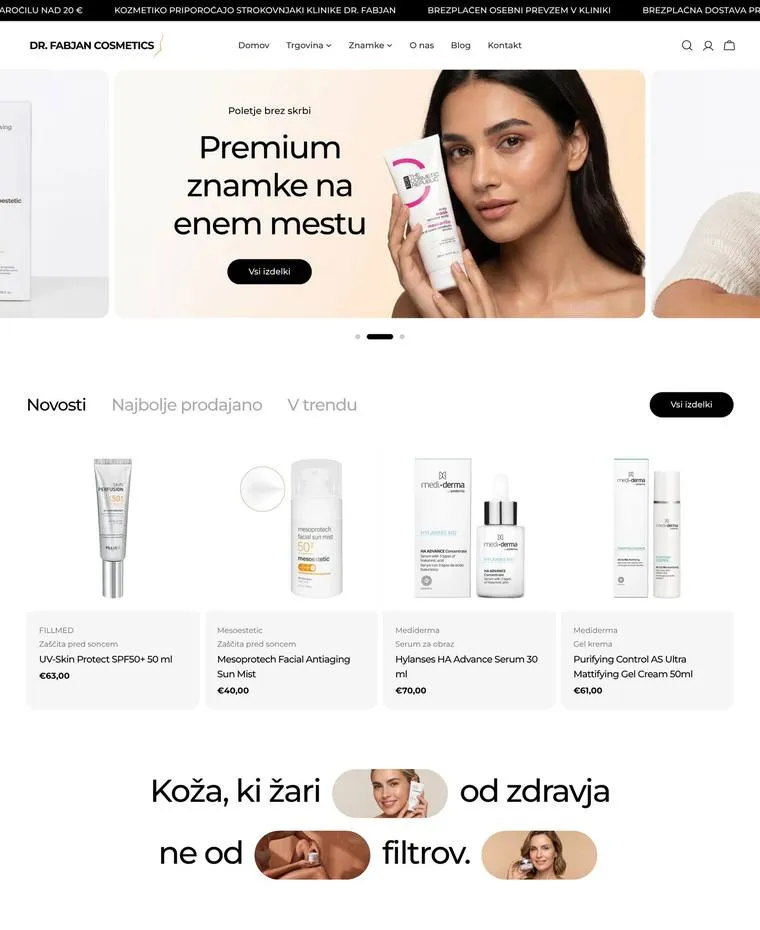
drfabjancosmetics.com
Dermocosmetics · Shopify
Dr. Fabjan Cosmetics
The dermocosmetics shop of the Estetika Fabjan clinic. We run its Shopify store, its campaigns and the email flows behind every order.
32products
6core flows
8automated cart and checkout emails
Revija, the clinic magazine we make, is read by 200,000+ patients a year.
svet-kozmetike
Cosmetics · webshop
Svet Kozmetike
A cosmetics shop with products from six brands. The post-purchase, abandoned cart and first-order flows run there too.
80products
6brands
3flows running
pitbull-sport
Outside healthcare · built from nothing
Pitbull Sport Slovenija
No domain, no emails and no shop before us. We opened the webshop, entered the products, wrote the descriptions, made the visuals and built the brand, then ran every ad.
92products
6ways to pay
3flows running
The same post-purchase, abandoned cart and first-order flows run in all three shops. The revenue figures stay theirs; what we show here is what we built.
Both, and we prefer both. When the shop and the ads are built by the same team, the conversion rate has an owner.
02
What about health claims in the ads?
We write what the product can say, in the language each platform accepts, and we keep the proof on the page. A restricted ad account costs more than a careful sentence.
03
Which email platform do you work in?
The one connected to your shop. We build the flows there and hand you the account, the templates and the logic. Nothing is locked to us.
04
Do you write the product pages too?
Yes: what is in the product, what it is for, how to use it and what the reviews say, written within the claims rules of each market and checked against the label. Product pages are where most claims problems start, so we treat them like ads.
05
We also sell through pharmacies. Is that a problem?
No. The shop does not have to win on price. It wins on what a pharmacy cannot give: the advice, the clinic or the brand behind the product, and the reminder when it runs out. We plan the campaigns so they do not undercut your retail partners.
06
How do you report results?
New and returning customers, split by product line and market: the cost per first order next to the returning share, every month. A blended return on ad spend hides the second order, so we never report only that.
The playbook, in full
The Second Order Is Where the Brand Starts: Acquisition and Retention for Healthcare Brands
Most health and beauty brands spend everything on the first order and send a newsletter after it. The margin lives in the second order, and the second order is built, not hoped for.
Show us your shop and your last three months of orders.
We will tell you what a first order costs you, how many customers come back, and which flow we would build first. The second order is usually closer than it looks.
A confirmation within 24 hours. A clear answer within 72.
Cookies
Essential cookies run the site. Analytics and advertising cookies load only if you agree.
Cookie Policy